The Impact of Steel
Chapter 2: The Listening Years
In the quiet hours, when the sun had dropped and the house felt smaller, Joshua would sit at the old kitchen table. The one his mother never replaced, even after the legs started to give and needed a folded magazine to keep them honest. A lamp hummed in the corner, its yellow light spreading across the chipped linoleum and turning the room into a small island of color.
Mary would read aloud from the Bible. Her voice didn’t waver. She never preached, never underlined, never paused to explain. She just read, steady and sure, letting the words land where they may.
One night, she closed the book and let her hand rest on the worn cover before looking across at him. “Do you understand why this matters?”
Joshua nodded, but his brow stayed tight. “I think so,” he said. “But it doesn’t all line up. Some of what I’ve read—the Quran, the Book of Mormon… it feels different to me. Not wrong. Just… like it stops a step before wherever my head keeps going.”
Mary didn’t correct him. Didn’t flinch. She reached across the table and set her hand over his, palm rough from work. “Curiosity’s where wisdom begins,” she said. “You follow where it leads. Ask your questions. You’ll come back stronger.”
She didn’t say more. She didn’t have to; the weight of her hand stayed on his longer than the words did.
~~~
Joshua followed that thread. He read the Quran cover to cover, drawn to its cadence, its steady insistence on compassion and obedience. The Book of Mormon pulled him in with its strange echo of stories he half-knew and the quiet suggestion that revelation didn’t end when the ink dried.
He dug into the sermons of Martin Luther King Jr.—justice stitched to mercy, never one without the other. Gandhi showed him what strength without force could look like. Mother Teresa revealed what quiet suffering could become in the hands of someone who refused to turn away.
Confucius gave him order. Hinduism, a sense of breath moving through all things. Each new teaching didn’t replace what he knew—it layered over it, pressed against it, reshaped the outline.
He kept going.
Buddha taught him breath and stillness and the quiet war between wanting and peace. Judaism’s grounding in law and memory struck a chord—rigid at times, but aimed at fairness. Sikhism added fire and selflessness. Taoism softened the edges again—flow, humility, the strength of not pushing.
From Stoicism, he learned how to stay steady in a storm. From existentialism, how to choose without excuse, how to carry the weight of choice like it was meant to be carried.
Each text handed Joshua a different lens. Not just new rules or rituals, but angles—ways of seeing people, power, pain. Over time, the fragments started to lean toward each other. Not perfectly. Not clean. But honestly.
He didn’t abandon the faith he’d grown up with. He widened it—stitched new cloth into the old coat. Justice here. Mercy there. Certain patterns began to repeat across borders, across centuries. The farther he read, the more he saw them: the same threads—truth, dignity, compassion—woven by unfamiliar hands.
It didn’t make the world simpler. But it made it clearer.
That mix held it together for him—not a blend, not a blur, just connection. Each path carried its own weight, its own beauty. Together, they gave him a language he could use across lines. And a reason to try.
~~~
Back in the shop, sawdust clung to his forearms like it lived there, settled into scars and calluses he never bothered to hide. His hands stayed busy—planing, sanding, measuring—but his mind kept drifting. The teachings stayed with him. Not as doctrine. Not as dogma. Just motion, like breath. They shaped what he reached for, even when he wasn’t thinking about them.
That summer evening, the sky leaned into orange and gave the porch a kind of soft silence. Joshua sat beside Mary on the steps, shoulders hunched the way they always were when he was thinking too hard and trying not to show it. Crickets started up near the ditch by the road, a thin, steady chorus under the fading light.
He spoke without preamble. “I’ve been thinking about everything I’ve read,” he said. “How all these teachings—Jesus, Buddha, Muhammad—they’re not at odds. Not really. They just… emphasize different things. But the heart of it feels the same. Justice. Empathy. Harmony.”
Mary looked out toward the horizon, where the last strip of sun sat low on the fields. “That’s not something most people figure out,” she said.
Joshua shrugged, a quiet smile pulling at one corner of his mouth. “Maybe they’re just not looking for the common parts.”
She turned toward him, her face gentler than the light. “You’ve done something rare, son,” she said. “You’ve listened.”
He felt it hit his chest—something tethered, something real. “I want to share it,” he said. “I think this could matter, Mom. I think it could help.”
Mary didn’t rush to answer. Her hand found his, light and steady. “Then share it,” she said. “The world doesn’t need louder voices. Just better ones.”
He nodded, eyes narrowing the way they did when he was piecing something together, locked on the last strip of gold edging the clouds.
“What if we’re all parts of the same truth?” he asked. “All of us. Different names, same story.”
Mary’s face didn’t change. She just watched him. “Why do you think that?” she asked.
Joshua picked at a rough corner of the porch step with his thumb. “Because when you strip the labels off—Christian, Muslim, Buddhist—what’s left sounds the same,” he said. “Kindness. Humility. Service. I think we’ve spent centuries arguing about the accent instead of hearing the message.”
Mary leaned back slightly, hands settling in her lap. “You think even the contradictions point to something greater?” she asked.
“Some of them,” Joshua said. “Others… I think they’re just human. Additions. Edits. Fear disguised as faith.”
She didn’t agree. Didn’t disagree. Just nodded once. “Go on.”
Joshua leaned forward, elbows on his knees, shoulders drawn in like he was trying to make room for the thoughts instead of himself. “Confucius put honesty at the center of everything,” he said. “Harmony too—how people move around each other without causing damage. Buddha came at it from another angle. Mindfulness. Ethics. A calmer path to the same place, just walked differently.”
Mary watched him, patient. “And the others?”
“Sikhism talks about equality and serving without expecting anything back,” he said. “Same kind of heart Mother Teresa carried. Taoism, Gandhi—they’re both about keeping life simple and staying close to what’s real. And the Stoics… they sound a lot like Buddha when they talk about training the mind, not letting emotions flip you over.”
Mary smiled, faint but warm, like she was seeing something settle into place in him. “So how do these pieces fit?” she asked. “In your mind.”
Joshua leaned forward a little more, gaze steady on the small glow of the tablet screen resting on his knees. “If you step back far enough, the patterns line up,” he said. “Not the rituals—those change. But the foundations: love, generosity, justice, honesty, harmony. They show up everywhere. You can feel them even when the language shifts.”
Mary slid her hand over his again, her tone gentle but firmer than before. “But why call them flawed?” she asked. “Why assume these teachings have shortcomings? The Bible is God’s word, Joshua. How can you question that?”
He didn’t pull his hand away. Just held still, jaw tightening in that quiet, stubborn way that meant he was taking every word in. “Because people wrote them, Mom,” he said. “People doing their best to make sense of things. Every faith says its book came from God. It’s hard to believe they’re all literally right in the same way. But if you look past the parts shaped by culture or fear or authority… you find the same core values underneath. Those are the pieces I trust.”
Mary’s brows knit together, confusion tugging softly at her expression. “So you’re saying there’s no real divine being?” she asked. “That God isn’t real? Joshua, I didn’t raise you to believe that. How can you say that?”
“I didn’t say there’s no God,” he answered, voice low. “I said the idea might be bigger than a figure in the sky. Maybe God isn’t a person at all. Maybe whatever we’ve been trying to name lives inside people—what we choose, how we treat each other. When every religion says it has the one true God, either they’re all right, or none of them are. It feels more honest, for me, to focus on the principles instead of the packaging.”
Mary took a long breath, letting it out slow. Her eyes held something complicated—concern, admiration, maybe both. “I don’t agree with you,” she said at last, voice quiet but steady. “Not all of it. Maybe not most of it. But I see how hard you’re trying to understand things for yourself. And I respect that more than you know. So keep going. Keep asking questions. And use what you learn to help people. That’s what matters.”
Joshua’s grin came small but certain. “I will, Mom.”
He sat back from the screen, eyes tired but focused. Sometime during the talk, the porch light had flicked on behind them, casting a soft glow through the kitchen window. The coffee beside him had gone lukewarm. Mary still hadn’t pulled her hand away.
“You’ve got a gift,” she said quietly. “Even if I don’t see it all the way you do.”
Joshua gave her a faint smile. “I just want to help.”
“Then help,” she said. “But stay honest while you do.”
She stood, carried her cup inside, and rinsed it in the sink. She didn’t say another word. The conversation just stayed with him—settled in the way that doesn’t shout, doesn’t flare. It lingered instead, quiet and rooted, like something that had finally found soil.
~~~
After that night, his hands didn’t change. His days didn’t either. But something shifted behind them.
He mended a neighbor’s fence without being asked. Held groceries for a woman juggling two kids and a declined card. Walked a boy home after finding him crying behind the library. Nothing big. Nothing anyone would write up.
But each thing came with intention now. He wasn’t just helping. He was practicing—living into something he hadn’t named yet.
The town noticed. Not with banners or speeches. In smaller ways. Folks started waving more. Started pausing. Started looking for him when something stuck, broke, or wouldn’t budge.
He didn’t ask for it. Didn’t want it. But people came anyway.
Not because he was a prophet or a preacher. Because he listened. Because he didn’t look away when someone cracked. Because his quiet felt like space, not distance.
The stillness around him felt deliberate—like he’d learned how to let silence do part of the work.
Emporia didn’t change overnight. But it shifted. One fence. One ride. One kitchen table at a time.
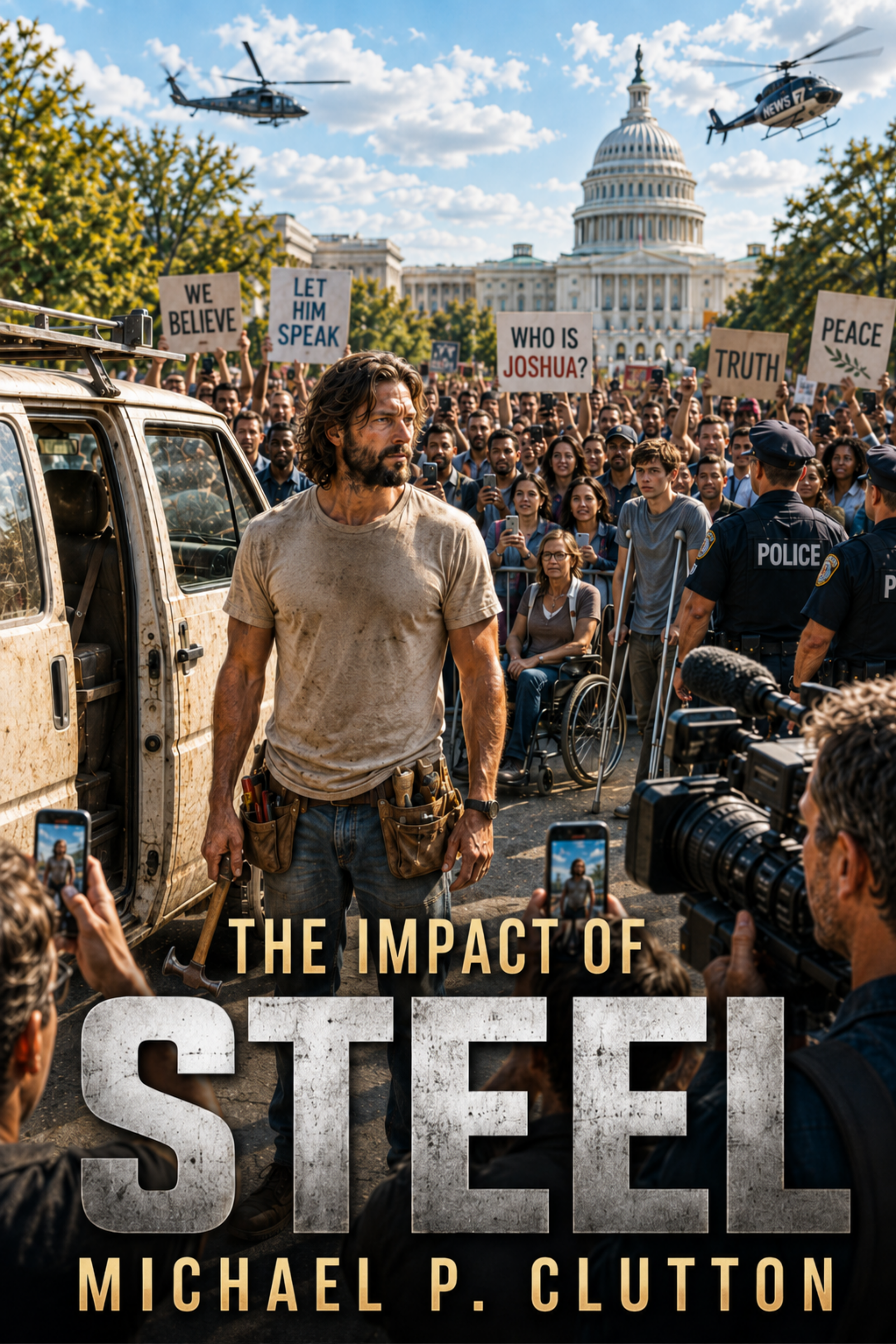
His life still looked plain from the outside. Same boots. Same tools. Same creaking van with the rusted side panel.
But it wasn’t plain anymore. Under every step, every errand, every kind word, there was a thread pulled from a hundred teachings and stitched, carefully, into something that felt like his.
Joshua never claimed he’d found the answer. But he knew what it wasn’t.
It wasn’t fear.
It wasn’t dogma.
It wasn’t waiting for someone else to do the work.
It was choosing now, with what he had. And the road ahead was open.