The Impact of Steel
Chapter 1: Genesis of Hope
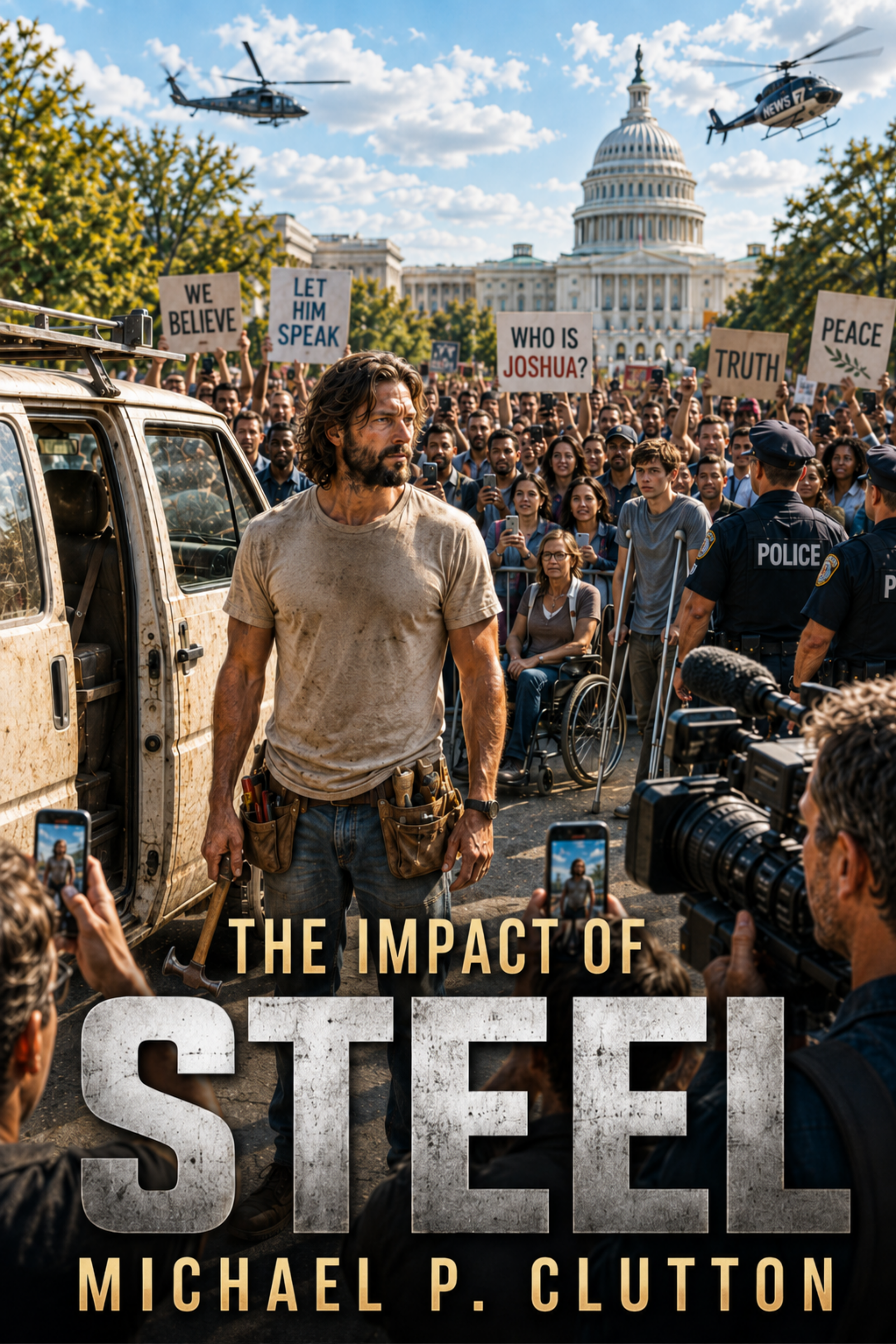
Prologue
After dusk, the world slipped into its darker rhythm. Streets carried the weight of unrest, city after city pulsing with anger that refused to settle. Pavements once filled with routine now shook with marching feet and voices raised for change. Sirens drifted through the air—sometimes close, sometimes only a thin wail on a screen—like alarms no one seemed able to shut off.
In Europe, crowds pressed against police lines in the old stone squares of Paris and Berlin. Tear gas rolled low across cobblestones while shields locked tight, visors catching the flicker of firelight from burning trash and flares. People didn’t back down; they planted their feet and held their ground while the footage looped on late-night news.
Across Asia, candles burned in the shadows of skyscrapers. Small vigils lit patches of concrete as mourners stood shoulder to shoulder, grief settling into the night like a weight. Governments cracked down quickly, trying to cage the unrest, but scattered pockets of hope kept rising through the smoke, one sidewalk, one back street at a time.
In much of Africa, the struggle showed up in shorter segments and softer headlines, but it cut just as deep. Market stalls sat empty, their tarps fluttering like abandoned sails. Hunger threaded itself through neighborhoods where mothers scanned the horizon for answers that never arrived. Wind carried the sound of it all—frustration, fatigue, longing—a rough chorus drifting along streets most of the world didn’t look at for long.
And yet, beneath the noise and suffering, something steady had already begun to grow. A different kind of movement—small, quiet, stubborn. Like roots pushing through hard soil where no one expected anything to take hold.
In Emporia, Kansas—a place far from headlines and riot police—a young carpenter kept tending those roots one simple act at a time. Joshua didn’t look like a revolutionary. He didn’t speak like one. But real change rarely starts with spectacle. It starts small, like a seed tucked into hard ground, and Joshua lived as though that were the only way anything ever really shifted.
He gave what he had. He carried what others could not. He lifted, built, repaired, and listened. Small things. Ordinary things. But kindness has a way of multiplying when the world is tired, passing from one person to the next before anyone realizes it’s moving.
If nurtured, those acts could spread—steady, patient—quiet as word of mouth, strong enough over time to start replanting what had been stripped away.
While nations strained under the weight of corruption and grief, Joshua worked with a worn bit of scripture in his back pocket and his mother’s wisdom in his bones. He struggled with purpose, but he didn’t turn from it. He let the uncertainty press against him until it sharpened, the way a blade meets stone.
The world was changing. Cracks had opened. People were searching for something—hope, direction, a reason to believe things could shift for the better and stay that way.
Somewhere in all of it stood a man in worn boots and a dusty shirt, driving an old van across the Midwest. A craftsman with steady hands. A man trying to do good in a world that kept breaking faster than most people could fix it.
A savior? No. Not in his own eyes. Not in anyone else’s, not then.
Just one man.
And how could one carpenter—barely scraping by—matter at all to a world already on fire?
1. Genesis of Hope
The workshop sat near the edge of town, walls warped by time and summers. Inside, the scent of pine dust and varnish held tight to the air. Late-morning light cut through the dirty windows, catching motes mid-spin and tracing the long arc of his arm. Joshua worked in silence. Each stroke of the chisel, each soft tap of the mallet, carried the same slow precision.
He didn’t hum. Didn’t rush. The rhythm did the talking, steady enough to feel like a promise.
Still, the world crept in. Even here. Static voices from radios in passing trucks, headlines half-heard when he grabbed coffee at the diner, anchors stitching anger into neat segments between ads. Joshua leaned against the bench, arms loose at his sides. He didn’t close his eyes. Just listened—to sawdust settling, to silence pressing up from beneath the noise like something trying to hold.
He tried not to picture it, but the news made it hard. Europe came first—wet streets, fists raised, chants bouncing off glass as riot footage looped. Asia came quieter—votives along sidewalks, signs held in still hands, grief kept close while cameras stayed wide. Africa didn’t get much screen time at all, just a few seconds of empty stalls and thin faces that sat with him longer than the anchors’ voices. Not pity—weight. The kind that came from being overlooked for too long.
His own life wasn’t loud. It was worn denim, early mornings, the hum of a fan over tired tools. Still, those news clips sat in his chest and refused to leave. Not guilt. Not grandeur. Just a sense that maybe the quiet things mattered too—maybe even here, in a town most maps ignored, something could shift.
Ripples were small. You rarely saw where they ended—only where they started.
Joshua picked up the hammer again. Each tap came like a breath. Not a pledge. Not a manifesto. Just motion. Just work. The world outside could twist itself into knots; here, for a little while, things held shape.
Emporia lay low between Topeka and Wichita, stitched together by K-99, US-50, and the long drag of I-35. Grain silos shared skyline with dorm towers. Students moved fast, eyes on phones and deadlines. Locals moved steady, eyes on weather and bills. The town breathed in two rhythms—one rooted, one restless—and Joshua lived in the seam between them.
Joshua didn’t own much. Didn’t need to. Jeans faded to gray at the knees, shirts that rarely saw a hanger, boots older than some of the students passing by. His business card was the work itself—tables that didn’t wobble, chairs that didn’t squeak, doors that finally closed right. He never advertised. He didn’t have to. His work showed up for him—quiet, strong, lasting.
The table was almost done. Oak, smooth-grained, wide enough for a family to sit tight around it come winter. Joshua ran his palm over the finish and felt for any small snag that might catch a sleeve. A final pass with oil. A check on the legs. His thoughts stayed inside the grain, inside what he could plane and sand and fix. Outside, the world shifted. Inside, nothing moved that shouldn’t.
The bell above the door gave a half-hearted ring. Joshua didn’t flinch. He knew that step. David walked in, wiping his palms on his jeans, brow drawn like he’d just come from a place with too much noise and not enough answers.
“Got a minute?” David asked. He wasn’t loud, but the pressure was there. Joshua set the rag down without answering, already turning his body toward him.
Joshua wiped the back of his neck, thumb catching on a line of dried sawdust. “What’s wrong?”
David scanned the shop like the walls might judge him. “Europe’s on fire again,” he said. “Protests. Riots. Whole squares packed. Politicians pretending they can’t hear. Feels like the whole continent’s one big pressure cooker.”
Joshua gave a slow nod. “It’s hard,” he said. “But pressure breaks things open, too. Sometimes for the better. Depends what people do with the crack.”
David leaned into the bench, ran a hand through his hair—habit, not grooming. “Just feels like we’re standing still while everything burns,” he said. “Dropping pebbles in a volcano. You ever wonder if we’re doing enough?”
“There’s always something,” Joshua said. “But it doesn’t come all at once. You move right. Sometimes others follow.”
“You think it’s really that easy?” David asked. Not mocking. Just tired. The question hung there like dust in the light.
Joshua shrugged. “Simple’s not the same as easy,” he said. “Doesn’t mean it’s cheap.”
David exhaled, shoulders easing. “Since when did you start sounding like an old monk?” he asked, but the edge in his shoulders had already dropped a notch.
Joshua grabbed a rag and lobbed it at him. “Right place, wrong time,” he said, mouth tugging at one corner like he wasn’t sure if he was allowed to smile yet.
He didn’t mean to sound wise. He just meant it. If it steadied David for a few hours, that was enough.
Later, Joshua strapped the finished table in back and eased the van down Merchant Street. Emporia moved at its usual pace—students with earbuds and coffee cups, retirees on porch swings, half-finished sidewalks waiting for funding. A protest livestream flickered across a phone screen at a crosswalk, sound off, fists rising in silence. The town wasn’t perfect. But it knew who it was.
Joshua parked in front of the bungalow, engine ticking as it cooled. Mr. Thompson met him on the porch, cardigan loose, smile settled deep in the corners of his face, like the lines had been carved there over a long, patient life.
“Joshua,” he said, stepping aside. “Glad you made it. Come in.”
Joshua unloaded the table without a word. He navigated the narrow hallway, past framed family photos and a leaning coat rack, then set the piece down in the dining room. It fit like it had been waiting there, slotting into the worn patch of rug where another table had once stood.
Mr. Thompson stood with both hands behind his back, nodding slowly. “Perfect,” he said. “You outdid yourself.” He held out a folded bundle of bills. “Should cover it. And maybe those bald tires that keep squealing past my window.”
Joshua flipped through the stack, paused when the count passed what they’d discussed. “That’s more than we agreed on.”
“Worth it,” Mr. Thompson said, waving him off. “I’ve never seen anyone work like you. Take it. Before I remember I’m on a pension.”
Joshua didn’t argue. He nodded once, then tucked the cash into his pocket, feeling the sudden weight against his thigh. The squeal of his own tires flickered through his mind, then David’s question about doing enough, then the news clips he’d heard that morning. He left the van where it was and walked the few blocks toward the diner, the street quiet except for wind scratching against the shop signs.
Just past the corner of Commercial, he spotted a woman hunched over the hood of a stalled sedan. The engine was silent. Her phone lit up, then went dark again, her thumb tapping the screen like she could will the signal back.
Across the street, two students waited at a bus stop—one still holding his phone up from a protest stream that had ended ten minutes ago, camera open and pointed loosely in their direction without him really thinking about it.
He stepped closer, keeping his voice level. “You need help?”
She looked up fast, relief flickering across her face and then tangling with embarrassment. “Yes. Thank you. It just died. I don’t have money for a tow. My mom’s watching my kids and I need to get home—she’s not in great shape. Do you know anything about cars?”
Joshua shook his head. He felt the money against his leg, the way it had felt like extra a minute ago. “Not a thing,” he said. He pulled the bills from his pocket, thumb hesitating for half a breath before he let the whole stack come free. “But this should cover the tow. And the ride. You’ll be alright.”
She stared at the money, then at him—hair tangled, shirt worn thin, boots dusty. “I can’t take this. Seriously, this is… too much. Thank you, but really—take it back. You don’t even know me.”
Joshua didn’t flinch. He took her hand, placed the cash in it, gentle but firm, and closed her fingers around the bills. “You’ve got somewhere more important to be,” he said. “Let them worry about the car. You just get home.”
He turned and walked on. She called after him, voice shaking. “Thank you! Really—thank you so much!” A car at the light idled through the whole exchange, driver watching from behind the glass.
He lifted one hand without turning around, more acknowledgment than wave, and kept walking.
At the diner, the bell above the door chimed. Warm air wrapped around him, thick with coffee and bacon grease. Tables were full, and the cash-shaped space in his pocket felt suddenly obvious. He hesitated at the threshold, looked down at his boots, then turned back toward the door.
Before he could reach it, a voice stopped him. “Hey. Come in.”
It was Sam—the owner—wiping his hands on a towel, nodding toward the counter. “Sit,” he said. “You’re covered.”
Joshua hesitated. “I’m not exactly clean. And I don’t have—”
“Doesn’t matter,” Sam said, hand landing gently on his shoulder. “Saw you out there. Gave away your lunch money to the lady with the dead sedan. Let me handle this part.”
Joshua looked around, unsure if he should argue. “I don’t want to take up space from someone paying,” he said, voice low enough that it barely cleared the counter.
“My diner. My rules,” Sam said. “Sit. Eat. Nobody here’s keeping score but me, and I’m calling this even.”
Joshua gave a half shrug, eyes still low. “Thanks, Sam,” he said. “That means a lot.”
Sam nodded and started to walk off, then paused, glancing back. “Why’d you do it?” he asked, not pressing. Just curious. “The money.”
Joshua didn’t flinch. “It was the least I could do,” he said. “Felt wrong to keep more than I needed when she couldn’t cover what she did.”
Sam didn’t answer right away. Just gave a slow nod. “World needs more of that,” he said. “Even if it doesn’t know it. Or film it.”
Joshua sat at the counter and ordered plain eggs, toast, black coffee. He didn’t rush the meal. Let the clatter and low chatter of the place wash over him like white noise. No one stared. No one asked anything. At a corner booth, a student in a campus hoodie glanced between his screen and Joshua, like he was lining up a grainy clip with the man in front of him, but he kept whatever he’d seen to himself.
When the plate was clean and the mug half-full, he stood. Not lighter—just... quieter inside, like the day had clicked half a notch into place.
The walk back took longer. Shadows stretched long across the sidewalk. Streetlights hadn’t buzzed on yet. Joshua kept his hands in his pockets, eyes down, not searching for anything else to fix and still catching small fractures anyway.
By that evening, a twenty-second clip from the bus stop hit a campus group chat—shaky, half-zoomed, Joshua mostly a blur in a work shirt as he pressed money into the woman’s hand. The caption read, Some dude just gave his whole paycheck to a stranger on Commercial. Emporia’s got saints now? A few likes, a line of laughing emojis, one comment calling it staged. Then the post slid down the feed with everything else. Joshua didn’t know it existed.
The workshop greeted him the same way it always did—smelling of old wood and oil, dust settling like snow on everything. He stepped inside, exhaled slow, and picked up his tools. The table-shaped gap on the sawhorses made the room feel briefly wider.
He didn’t need the world to change right away. He just needed the work to hold—and for now, that was the part within reach.